ADA Compliant Portable Toilets: Grab Bar and Water Closet Clearance Essential
When individuals ask about an ADA certified portable bathroom, they typically anticipate a quick solution, something like, "Just get the bigger unit." That is generally where trouble starts.
Size matters, however it is not the whole tale. An ada obtainable mobile restroom has to help genuine people in real problems. That suggests the customer has to have the ability to approach it, enter it, relocate inside it, use the commode, and leave it without dealing with the layout. If grab bars are set up in the incorrect place, or the water closet clearance is blocked, the unit may look accessible from the outside while failing where it counts most.
That space between appearance and real functionality turns up constantly at festivals, wedding events, community fairs, emergency response websites, and public jobs projects. I have seen event groups feel confident because they scheduled one ada portable bathroom, only to position it beside a sloppy area without steady course to the door. I have actually likewise seen an apparently available system become almost ineffective since materials, hand sanitizer stands, or waste bins were put right into the indoor corners that needed to remain clear.
If you rent, take care of, or area mobile washrooms, the basics deserve understanding. Not to become a code consultant overnight, but to prevent expensive misconceptions and to make much better decisions before distribution day.
The standard that manages the conversation
For portable bathroom services in the United States, the regulating government availability requirement is the 2010 ADA Specifications for Accessible Layout. That issues due to the fact that lots of people still rely on older guidelines, old specification sheets, or supplier language that appears reassuring yet is also unclear to be trusted on its own.
The existing baseline is not merely whether the device is "spacious" or marketed as wheelchair-friendly. The unit needs to please access demands that relate to toilet spaces, including the called for clearances, transforming room, door maneuvering requirements, and the placement and function of grab bars. The truth that a restroom is short-term does not remove those responsibilities. The Access Board has explained that the accessible-unit demand uses also at short-term events when mobile commodes are organized in a cluster.
That one point shocks people more often than it should. Short-lived does not mean optional.
There is one slim crease worth keeping in mind because it creates complication in the field. Older ADA product identified portable commode devices at building and construction sites utilized exclusively by construction personnel, and those were treated differently under the older scoping language. Individuals sometimes overgeneralize from that and think mobile systems are broadly exempt. They are not. For general ada portable bathroom rental circumstances, specifically when systems are provided for the public or for non-exclusive usage, the accessible-unit demand still matters.
What "5 percent obtainable" actually indicates on the ground
If you have a collection of mobile single-user toilet devices, at least 5 percent of the systems because cluster should come. In practice, most tiny rentals round this issue into a simple choice due to the fact that you can not offer a portion of a commode. If a site has a small bank of mobile devices, that generally implies a minimum of one obtainable device is needed.
The important phrase is "in each collection." That detail can get lost throughout site preparation. Suppose an occasion has one toilet bank near the entryway and one more near the food area. You can not securely think one ada compliant available portable toilet put in a far-off corner covers both groups. Each collection needs to be thought about on its own.
That matters for individual self-respect as long as conformity. A guest needs to not have to cross a parking area, crushed rock lane, or crowded festival grounds to get to the only available choice when every other guest has a neighboring option. The law concentrates on gain access to, yet the useful question is fairness.
An available portable device likewise needs to be identified with the International Symbol of Access. That appears simple, yet it is one more detail that obtains missed out on in the shuffle of occasion setup. If the icon is absent, customers may not understand the system is planned to offer the required functions. If the icon is present yet the route is blocked or the inside does not support use, the signage just highlights the failure.
Why grab bars and water storage room clearance are the heart of the layout
Most individuals discover the door size initially. Individuals that depend on the device observe the practical area around the toilet.
Grab bars and water storage room clearance are not ornamental add-ons. They work together. The bars give support for transferring, shifting equilibrium, maintaining while seated, and climbing. The clearance around the bathroom permits the individual to position wheelchair devices, align their body, and utilize benches the way they were meant. If either piece is wrong, the entire setup breaks down.
This is the component numerous customers and website organizers undervalue. They think about an ada-compliant mobile commode as a larger shell with a toilet someplace inside it. Access is a lot more specific than that. The toilet's place, the open floor location around it, the turning room in the unit, and the bar placement are all connected. You can not crowd one element without influencing the others.
In a permanent structure, https://pristineportablesil.com/ada-compliant-toilet-rental/ a negative layout might be evident throughout plan evaluation. In a portable device, issues commonly conceal in plain sight since every little thing is compact. A shelf mounted too reduced, a sanitizer dispenser placed where a wheelchair footrest needs to swing, or a cleansing contractor keeping added paper inside the unit can compromise the designated clearance even if the version itself was manufactured to meet requirements.
What "water storage room clearance" suggests in simple language
"Water wardrobe" is the official term the requirements make use of for the commode fixture itself. "Clearance" refers to the functional room around that component that needs to continue to be available.
That clear space is not empty by mishap. It is there so a user can come close to and place properly. In an easily accessible bathroom space, the clearances around the bathroom belong to just how transfers occur safely. Without that room, the grab bars can refrain their task since the individual can not get involved in the required placement to use them.
For mobile devices, that suggests 2 different concerns constantly need to be asked. Initially, was the device created and built to provide the needed relationships among the commode, wall surfaces, bars, and open flooring area? Second, is the device still being delivered, put, and kept in such a way that maintains those relationships?
The second concern is where compliance frequently deciphers. A toilet can leave the provider's backyard in great problem and come to the website functionally endangered. I have actually seen indoor garbage receptacles wedge right into the side clearance, cleansing tools left inside the unit, and short-lived handwashing devices positioned where maneuvering room was supposed to stay open. None of those adjustments feel significant to the person hurrying with setup. To the individual, they can be the difference between usable and unusable.
Grab bars are about placement, not simply presence
A great deal of non-specialists assume the access box is examined if the portable commode has bars affixed somewhere on the wall. Unfortunately, that is not exactly how it works.
The suitable standards require grab-bar rules to be met as component of the toilet-room technological needs. That implies the existence of bars alone is insufficient. Their partnership to the commode and surrounding clearances matters. They need to support use in the means the standards intend.
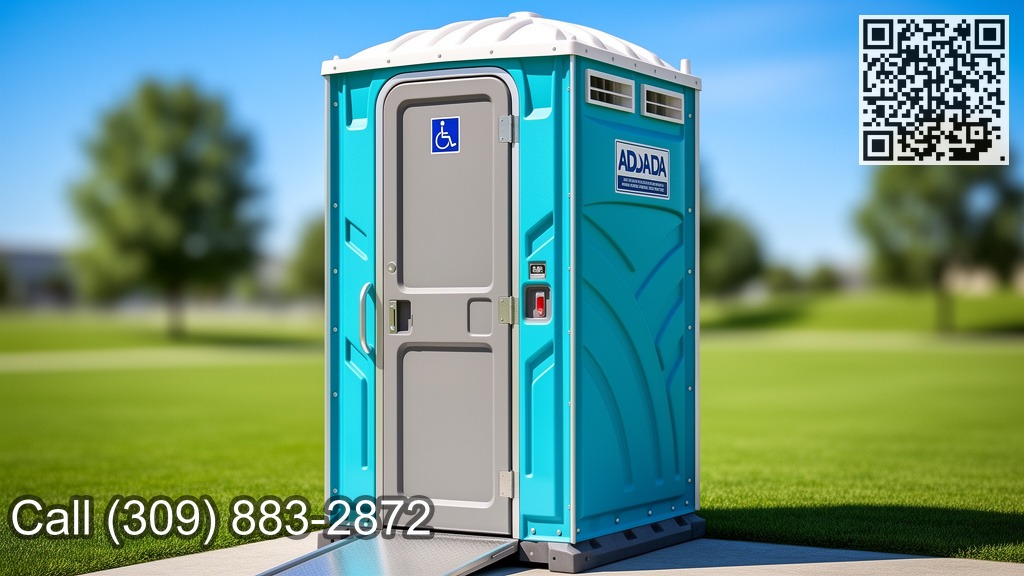
This is where jargon from sales pamphlets can muddy the water. Terms like "ADA style," "mobility device easily accessible," or "handicap unit" are commonly utilized loosely on the market. An ada handicap available mobile bathroom should not be evaluated by marketing language. It ought to be examined by whether it is really planned to meet the appropriate availability needs, consisting of the grab-bar and water storage room clearance rules.
That distinction is specifically essential when someone is cost purchasing. A lower-cost large device might feel like a wise replacement for an ada certified mobile restroom up until you learn that the indoor format does not maintain the required use zones. Once it gets on website, exchanging it out can be pricey, humiliating, or difficult on a tight event schedule.
The path to the system becomes part of the unit's usability
Even an effectively configured inside does not resolve the whole issue. The accessible system needs to get on an easily accessible path and have an obtainable entrance. If ramps or landings are required, those aspects additionally have to abide by ADA technical requirements.
This is among one of the most typical site-level failures since it occurs outside the system itself. A vendor may deliver an ada-compliant portable bathroom that is made appropriately, however the placement staff or occasion organizer can still create an obstacle by setting it on soft ground, on a steep strategy, behind curbing, or in an area where customers have to go across unpredictable surfaces.
Portable toilet preparation usually occurs after larger logistics decisions have actually already been made. The phase goes here, the providing tent goes there, the generators require this edge, the fencing cuts off that lane, and unexpectedly the "easily accessible" restroom ends up on the leftover patch of ground. Already, nobody means to leave out any person, yet exemption can still be the result.
Stable placement matters as well. If the system resolves unevenly, the limit and access experience can become more difficult. If the website obtains muddy after rain, an obtainable path that looked sensible in the early morning may be a mess by afternoon. Those are not theoretical problems. They are the type of things that divide a tidy compliance plan on paper from real accessibility in the field.
A word regarding clusters, circulation, and occasion timing
The 5 percent rule seems basic until the site has numerous task areas or staggered presence patterns. After that judgment comes in.
Imagine a weekend event with a household area, a performance area, and a vendor lane. If all the conventional devices are spread throughout those areas yet the only ada compliant mobile commodes are organized far from the busiest area, customers with specials needs are efficiently offered a various level of solution. The standards talk to amount and availability, however good planning additionally thinks about whether the accessible option is where people actually require it.
Timing issues also. Early in configuration, staffs frequently use the available device as a hassle-free storage space place due to the fact that it is larger inside. That is an awful behavior. I have seen boxes of wristbands, instances of water, folding indicators, and expansion cords tucked away in the one ada portable commode intended for public usage. By opening time, the products could be gotten rid of, however even short-lived abuse can bring about damage, dust, or missing out on accessories. More than once, the "final cleaning" never ever happened.
The kinder and smarter technique is to treat the accessible bathroom as the very first unit that obtains protected, not the last one that obtains checked.
Questions worth asking before delivery day
If you are organizing an ada portable bathroom rental, it aids to ask straight questions while you still have choices. Unclear confidence is not nearly enough, especially when the event host, homeowner, or specialist might later on be asked why the system picked was appropriate.
Here are the questions I most often suggest:
- Is this unit meant to fulfill the 2010 ADA ease of access needs for mobile toilet use?
- Will the system arrive related to the International Symbol of Accessibility?
- What website conditions are required for an obtainable route and entrance?
- If the washroom bank is split into more than one collection, how many available devices are needed?
- Are there any placement or maintenance methods that can interfere with interior clearances?
That short conversation can save a lot of clambering. It also tells you something concerning the provider. A firm that recognizes ada certified accessible portable restrooms should be able to answer plainly, flag restrictions truthfully, and assist you think through course and placement concerns rather than concentrating just on distribution logistics.
Common misconceptions that bring about avoidable mistakes
Some availability blunders take place because individuals overlook the rules. More frequently, they occur due to the fact that individuals believe they comprehend the policies and fill out the spaces incorrectly.
One typical misunderstanding is that obtainable device anywhere on the residential property resolves the issue. It does not if different collections are involved.
Another is that the within the system is the vendor's issue while the approach to the unit is the website host's problem, as if those can be separated nicely. In method, individuals experience them as one continuous path. If either side stops working, the outcome is still inaccessibility.
A 3rd error is presuming that a larger footprint provides everybody adequate room regardless of the fixture format. It may not. Clearances have to do with functional partnerships, not just square footage.
Then there is the language problem. People typically utilize phrases like ada compliant mobile toilet, ada-compliant portable commode, ada certified mobile washrooms, or ada-compliant portable toilets reciprocally. That is fine in table talk, but the wording can hide uncertainty. What issues is not the tag on the quote sheet. What matters is whether the device and its placement in fact satisfy the appropriate requirements.
Why this matters beyond technological compliance
There is a human side to this that must not be lost in compliance talk.
Using a mobile bathroom already asks a little persistence from lots of people. For someone with mobility constraints, that persistence can turn into anxiety extremely rapidly if the accessible option is missing, difficult to find, difficult to reach, or hard to use. Nobody wants to be the visitor scanning a jampacked occasion for the one significant system, just to discover the course is rough, the entrance is unpleasant, or the within is cluttered.
That experience remains. People keep in mind whether a site included them in a functional, considerate way.
There is also a more comprehensive context. ADA conformity is not getting lesser. If anything, enforcement and recognition remain to broaden across fields. Even organizations that made use of to think of accessibility as a narrow facilities issue are being required to take it a lot more seriously. Washroom gain access to is one visible item of that larger photo, and it is often the item people notice initially due to the fact that it affects convenience, dignity, and basic participation.
The most functional way of thinking to bring to the job
If you want to make good choices regarding an ada obtainable mobile bathroom, believe less concerning checking a box and even more about protecting an use case.
Picture a person showing up by the accessible route, unlocking, maneuvering within, positioning at the commode, utilizing the grab bars as intended, and leaving without unnecessary stress or improvisation. That easy mental walkthrough captures lots of problems prior to they become real.
It additionally changes the conversation in a healthier direction. Instead of asking, "Did we buy the ADA system?" you begin asking, "Can someone really use it conveniently and securely when they get there?" That is the far better question.
For website managers, that may indicate booking strong ground very early and maintaining that area clear. For occasion organizers, it may suggest distributing restroom clusters more attentively. For rental companies, it suggests being precise about what your systems are designed to fulfill and cautioning consumers when website conditions can undermine ease of access. For maintenance crews, it implies preserving interior clearances and not treating the obtainable system like overflow storage.
Grab bars and water closet clearance fundamentals might appear technical, however they are actually about everyday usability. The requirements require them since they fix sensible troubles people deal with whenever they use the toilet. When those information are valued, an ada mobile toilet does what it is supposed to do. It lets individuals take part in work, events, and public life without an avoidable barrier standing in the way.
 Ask ChatGPT
 Ask Grok
 Ask Perplexity
 Ask Claude
 Ask Google AI
 Ask You